
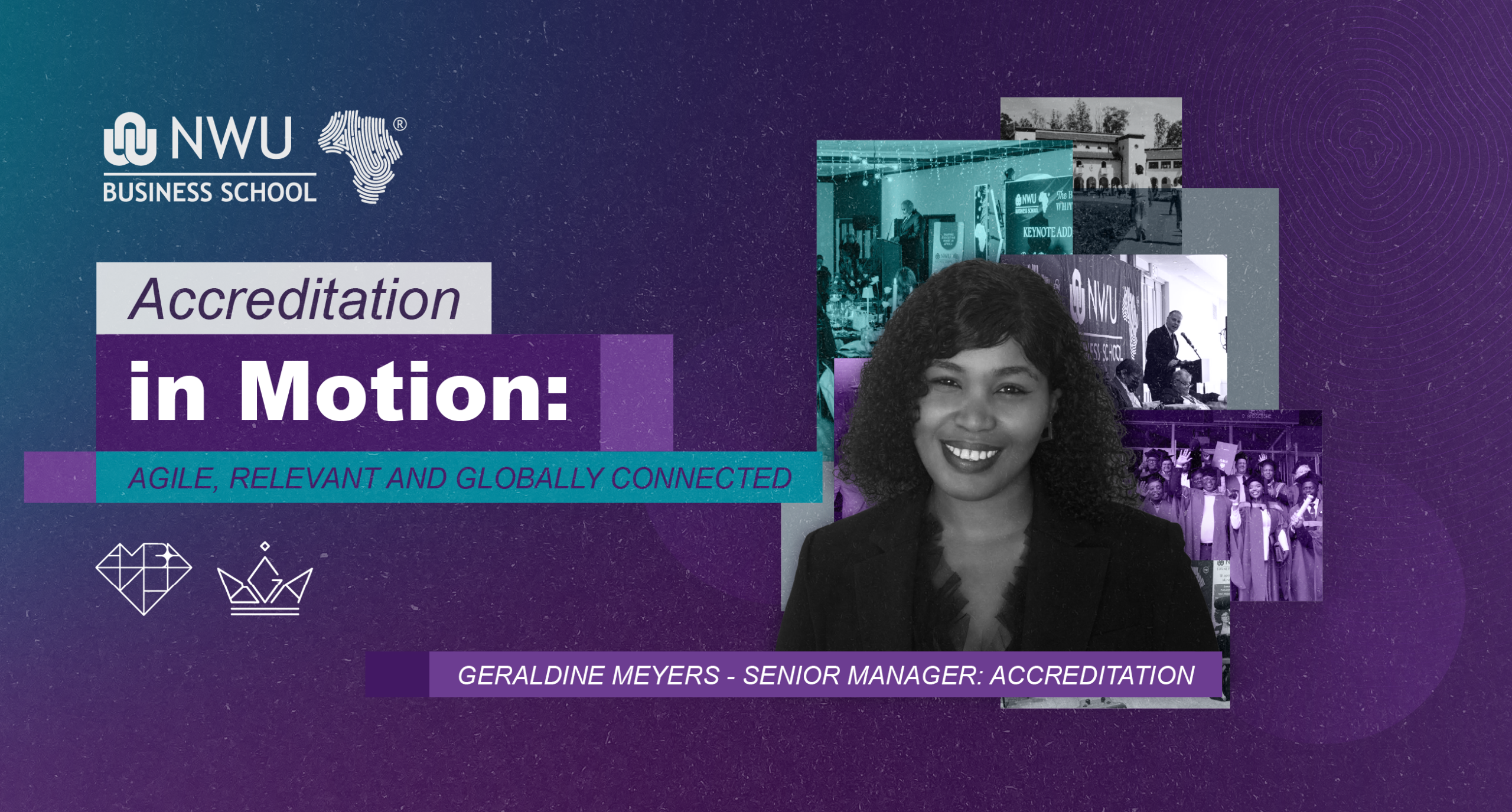
How accreditation strengthens evidence, learning and continuous improvement
As the NWU Business School continues its AMBA and BGA re-accreditation journey towards October 2026, one reflection has become increasingly clear: relevance cannot be assumed.
Relevance is not a title a business school carries permanently. It must be revisited, tested and renewed through the quality of its programmes, the experiences of its students, the contribution of its staff, the strength of its partnerships and the impact it creates beyond the classroom.
This matters because business education is changing. Students expect learning that is meaningful, flexible and connected to the world of work. Employers expect graduates who can think critically, lead responsibly and respond to complexity. Societies expect business schools to contribute to ethical leadership, economic development, sustainability and public value. Technology, including artificial intelligence, is also reshaping how knowledge is produced, accessed and applied.
In such an environment, staying relevant requires more than good intentions. It requires disciplined systems, credible evidence and the ability to turn reflection into improvement.
This is one of the important contributions of accreditation. It creates a structured opportunity for a business school to examine the relationship between what it intends to do and what is actually experienced by students, alumni, staff, employers and stakeholders. It asks whether programmes remain current, whether assessment practices support learning, whether feedback is used meaningfully, and whether partnerships continue to advance the School’s mission.
For the NWU Business School, the current re-accreditation cycle has sharpened attention to areas that sit at the heart of academic quality. Assurance of Learning helps the School understand whether students are achieving the intended learning outcomes. Assessment and moderation practices support consistency, credibility and academic fairness. Alumni engagement, stakeholder feedback and graduate impact help the School understand how its programmes create value beyond graduation.
These areas are connected by one important question: how does the School know that its work remains relevant and effective?
The answer lies in the quality of its evidence and in what it does with that evidence. Responsible management, ethics, sustainability and artificial intelligence form part of this same reflection. They speak directly to whether business education is preparing graduates for the realities they will face as leaders, decision-makers and citizens.
This is where the work of staying relevant becomes practical.
Documents, reports and templates are important, but they do not carry the full meaning of quality on their own. The real test is whether evidence is used to strengthen practice. Student feedback, alumni insights, stakeholder input, programme data, research activity and engagement initiatives all help the School understand where progress is being made and where further attention is required.
Evidence therefore has to move.
It must move from collection to interpretation, from interpretation to decision-making, and from decision-making to improvement. When evidence moves in this way, accreditation becomes more than a reporting process. It becomes part of how a business school learns about itself.
This movement of evidence also shows why staying relevant is shared work. It is carried in curriculum discussions, assessment practices, research activity, student support, alumni engagement, stakeholder partnerships and the systems that hold these areas together. Accreditation is therefore not located in one office, document or committee. It is reflected in the many places where the School’s mission is planned, enacted, experienced and improved.
The Accreditation Office plays an important coordinating role in bringing this evidence together, but the evidence itself lives across the School. It is found in the work of academic and professional staff, in the experiences of students and alumni, and in the partnerships that connect the School to the world beyond the classroom.
As we prepare for our AMBA and BGA re-accreditation visit in October 2026, the NWU Business School is preparing to demonstrate progress with confidence and clarity. Yet the deeper significance of this work lies beyond the visit itself. It lies in the School’s ability to show that quality is documented, understood, used and strengthened over time.
This is the work of staying relevant.
It is found in the discipline of listening carefully, engaging evidence honestly and allowing what is learned to shape what happens next. It becomes visible when student feedback informs teaching practice, when stakeholder insights strengthen programmes, when alumni experiences deepen the understanding of graduate impact, and when strategy becomes part of everyday academic work.
In this way, accreditation becomes more than a readiness exercise. It becomes a way of building institutional memory, strengthening accountability and supporting improvement across the School. It helps the School see where it is progressing, where further attention is needed, and how its mission continues to take shape in practice.
For the NWU Business School, the journey towards October 2026 is therefore about strengthening a culture of quality that can outlive any single visit, report or review cycle. It is about ensuring that evidence does not remain in files, that reflection does not end in discussion, and that improvement becomes visible in the lived experience of students, staff, alumni, partners and society.
This is how relevance is renewed: through the discipline to listen, the courage to improve, and the commitment to keep aligning purpose with practice. It is how the School continues to grow as a responsive, impactful and globally connected business school. A School where evidence becomes action, action becomes improvement, and improvement becomes impact.
At its most meaningful, accreditation is not only about meeting standards. It is about giving meaning to those standards through the value the School creates, the leaders it shapes, the partnerships it strengthens, and the contribution it makes to business, society and the continent at large.
Our Journey. Our Impact. Our Global Standard.